People of the Bible: Stephen

Stephen was one of the first prominent members of the church of Christ in Jerusalem, and was also one of the first to die for being Jesus’ follower.

The primary text about Stephen is Acts 6 through 8. Consider three stages of his life as revealed in Scripture:

Stephen the Minister

We first read about Stephen as a servant in the church (Acts 6:1-7). From the beginning, Christianity has been about community and helping others.  However, it is challenging to meet every need in the context of a variety of different demands and an array of personalities.  It is no surprise that a problem arose, in which some Christian widows expressed criticism that they weren’t receiving fair attention from the church.

The apostles announced a solution:  Select seven men who would be specially assigned to this task.  Stephen is the first name mentioned on the list, and he is described as “full of faith and the Holy Spirit” (Acts 6:5). His name is Greek, which lets us know that he had a Grecian background, which would be helpful in addressing the situation.

Based on the other descriptions provided, we also know that Stephen had a good reputation in the community (6:3), was “full of the Holy Spirit” (6:3), and was capable of tending to the job at hand.

Like Jesus, Christians should be servants.  Jesus said He came “to minister” (Mark 10:45), and He left us an example of humble service when He washed the disciples’ feet (John 13).

Stephen the Messenger

Next, we see Stephen as a spokesperson for the gospel (Acts 6:8-7:53). Stephen’s natural and supernatural abilities led him to a more public role in the church, particularly in leading Jews to Christ.   Those who wanted to protect Judaism were disturbed that they were unable to rebut Stephen’s teachings (6:10).

The contention between Stephen and the Jews became so intense that some of the Jews paid witnesses to make false statements about him, and he was placed on trial for blasphemy (6:11-15).

Christianity is an aggressive religion.  Jude said that we should be prepared to “contend earnestly for the faith” (Jude 3).

Despite the likely adverse consequences, Stephen delivered a powerful summary of God’s people under the Old Testament, and continued with a pointed application to his hearers (7:1-53).  They were turning from God’s plan in the same way God’s people had in the past (7:51-53).

Stephen the Martyr

The crowd was furious with Stephen (Acts 7:54). In the face of death, Stephen remained committed to Christ and entrusted the keeping of his soul to Him (7:55-60).

Jesus promised us that if we were “faithful unto death,” He will give us a crown of life (Rev. 2:10). “Stephanos” in Greek means “crown.” Stephen was stoned to death, and was buried by some of the devout men in the church (8:2).

The event sparked intense persecution of the church by the Jews, including Saul. Paul never forgot the day Stephen died, later reminding the Lord that he guarded the robes of those who threw the stones at Stephen and didn’t do anything to help him (22:20). Stephen’s death became a catalyst for others to look to Jesus.
Keeping Our Hearts Pure

One of the Beatitudes emphasizes the importance of maintaining a godly conscience: “Blessed are the pure in heart: for they shall see God” (Matt. 5:8). To cultivate that kind of freedom from corruption or inappropriate desire, consider these questions Fletcher of Madeley reflected on nightly:

  1. Did I awake spiritual, and was I watchful in keeping my mind from wandering this morning when I was rising?
  2. Have I this day got nearer to God in times of prayer, or have I given way to a lazy, idle spirit?
  3. Has my faith been weakened by unwatchfulness, or quickened by diligence this day?
  4. Have I this day walked by faith and eyed God in all things?
  5. Have I denied myself in all unkind words and thoughts?  Have I delighted in seeing others preferred before me?
  6. Have I made the most of my precious time, as far as I had light, strength, and opportunity?
  7. Have I kept the issues of my heart in the means of grace, so as to profit by them?
  8. What have I done this day for the souls and bodies of God’s dear saints?
  9. Have I laid out anything to please myself when I might have saved the money for the cause of God?
  10. Have I governed well my tongue this day, remembering that “in a multitude of words there wanteth not sin”?
  11. In how many instances have I denied myself this day?
  12. Do my life and conversation adorn the Gospel of Jesus Christ?

Going Right When Others Go Wrong

Friends and family are some of life’s greatest blessings. We enjoy a special bond with them, and share good times and bad times together. However, these relationships also present unique challenges.

From a spiritual standpoint, Satan utilizes every means possible to gain an advantage. It should be no surprise that one of the avenues used to interfere with our spiritual wellbeing would be through the influence of those who are closest to us. No one is perfect, and even though we may respect and care about others very much, they can make mistakes, give misguided advice, or approve of ideas that may not be accurate or acceptable to God.

One of the most important qualities a person can develop is the capacity to do what is right even though everyone else isn’t. Jesus taught, “If any man come to me, and hate not his father, and mother, and wife, and children, and brethren, and sisters, yea, and his own life also, he cannot be my disciple. And whosoever doth not bear his cross, and come after me, cannot be my disciple” (Luke 14:26-27).

The Bible contains several passages challenging us to be careful when those who are close to us exert pressure  to pull us away from God’s plan for our lives:

  • Exodus 23:2 – Don’t follow the crowd, especially when it is chasing evil.
  • Deuteronomy 13:6-8 – Don’t follow others when they worship other gods.
  • Psalm 1:1 – Be careful about hanging around with those who have evil attitudes and ideas.
  • Proverbs 1:10-15 – Don’t listen when others try to persuade you to engage in inappropriate behavior.
  • John 18:15-27 – Trying to blend in with those are do not share your faith in Christ can tempt you to deny your faith.
  • I Corinthians 15:33 – Listening to those who doubt God and His message can weaken our faith.
  • Galatians 2:9-13 – No matter how conscientious we may usually be, we can be affected by the ideas of our friends and associates.
  • Galatians 6:1 – When we are attempting to help a friend with a spiritual problem, we should remember that we are also susceptible to the influence of sin.
  • Matthew 7:13-14 – When making decisions about which path to take in life, our choices should be determined by considering where the path will lead, and not with the direction that others may be going.

Overcoming Disadvantages

It’s easy to look at what others have, and then to focus on what we don’t have, and to develop the idea that nothing is worth the effort because of our disadvantages.

Does success ever come easy, though?

While visiting in the office of a successful business woman who had a very stressful job, I noticed a plaque on her wall which read: “The happiest people don’t necessarily have the best of everything, they just make the best of everything.”

Choose to have faith in God, and depend on Him. With His help, disadvantages can be turned into points of strength.

“We are troubled on every side, yet not distressed; we are perplexed, but not in despair; persecuted, but not forsaken; cast down, but not destroyed. . . . Knowing that he which raised up the Lord Jesus shall raise up us also by Jesus. . . .” (II Cor. 4:8-9, 14a).

The Lord’s Righteousness

Jeremiah prophesied that the Messiah would provide our way to stand right with God: “In his days Judah shall be saved, and Israel shall dwell safely: and this is his name whereby he shall be called, THE LORD OUR RIGHTEOUSNESS” (Jer. 23:6).

First, Jesus portrayed righteousness. Isaiah prophesied that the Messiah would be a warrior against evil: “For he put on righteousness as a breastplate, and an helmet of salvation upon his head; and he put on the garments of vengeance [for] clothing, and was clad with zeal as a cloke” (Isaiah 59:17). Indeed, Jesus was the epitome of living righteously. He withstood the devil’s temptations like no other (see Matt. 4:1-11). Peter emphasized that Jesus “did no sin, neither was guile found in his mouth” (I Peter 2:21). He is the only man who never sinned (Heb. 4:15). He “knew no sin” (II Cor. 5:21) and was “separate from sinners” (Heb. 7:26, cf. Luke 23:47).

Second, Jesus proclaimed righteousness. Not self-righteousness (Matt. 23:28; Luke 5:32, 18:9; Prov. 30:12; Rom. 10:3), but a conviction that without Him we are nothing (John 14:6, 15:5; Phil. 3:9). He followed Scripture to “fulfill all righteousness” (Matt. 3:15).

Third, Jesus provides righteousness. His obedience (on our behalf) enables us to claim His righteousness (Rom. 5:19). Paul explained, “For he hath made him to be sin for us, who knew no sin; that we might be made the righteousness of God in him” (II Cor. 5:21). He supplies righteousness (Rom. 3:26, 4:5; I Cor. 1:30). We can be “dressed in His righteousness alone,” if we are humbly obedient to Him (Titus 3:5; Acts 10:35).

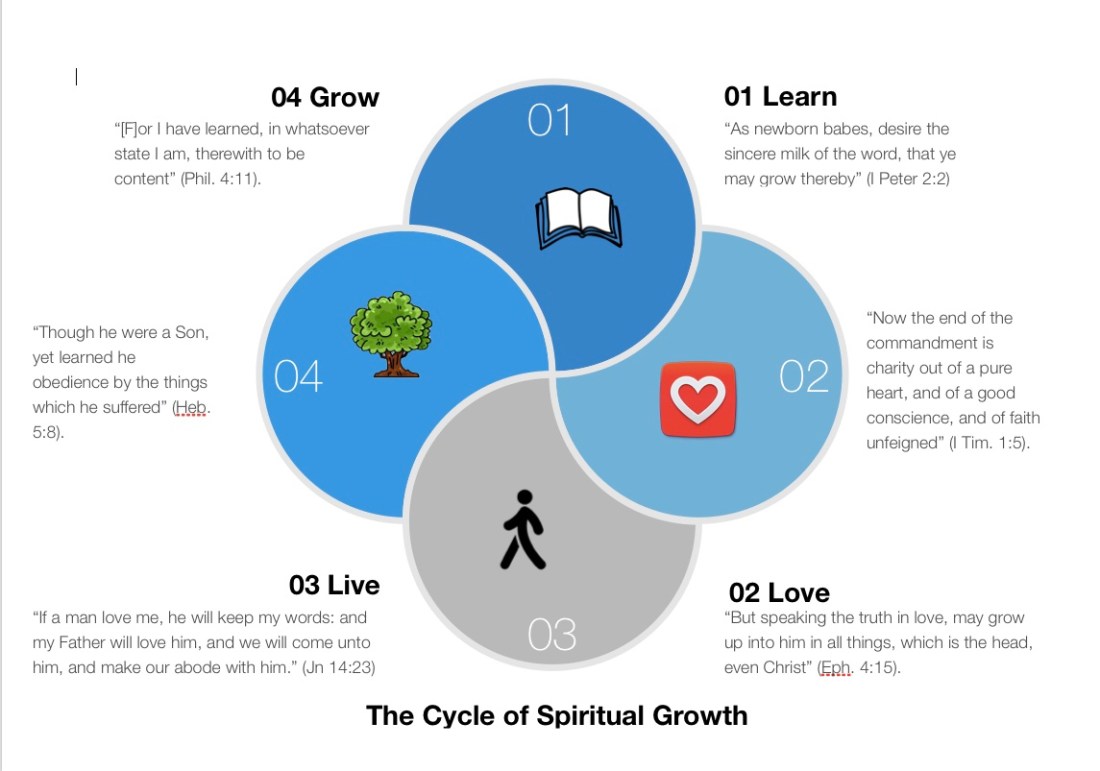
The Cycle of Spiritual Growth

Join us on Sunday mornings during August 2016 for a study of the process of spiritual development. It begins with LEARNING, which, if internalized and applied, will lead to LOVING and LIVING for God. As we live for Him, we GROW and are able to appreciate more of what He reveals to us in His word. And the cycle of spiritual maturity advances.

Here is a quick overview of each stage of growth:Cycle of Growth CHART 2016-08-12 at 9.48.29 PM

Six Tools for Spiritual Growth

We’ve got a lot of growing up to do… spiritually, that is. Peter urged us to “grow in grace, and in the knowledge of our Lord and Saviour Jesus Christ” (II Peter 3:18). Consider six tools we can use to help us on our path to spiritual maturity:

1. Get into the Word. God’s word has been given to help us on our journey. “All scripture is given by inspiration of God, and is profitable for doctrine, for reproof, for correction, for instruction in righteousness: That the man of God may be perfect, throughly furnished unto all good works” (II Tim. 3:16-17). “Perfect” means spiritually mature.
2. Work out your faith. Do what you know God wants you to do. “But whoso looketh into the perfect law of liberty, and continueth therein, he being not a forgetful hearer, but a doer of the work, this man shall be blessed in his deed” (James 1:25).
3. Send up your prayers. Jesus believed in prayer, too. “And in the morning, rising up a great while before day, he went out, and departed into a solitary place, and there prayed” (Mark 1:35).
4. Upgrade your level of service. If you aim to do your best in every area of life, especially in your religious life, you will improve across the board. “And whosoever shall compel thee to go a mile, go with him twain” (Matt. 5:41). “Just enough” ain’t enough.
5. Share the love. The sign of spiritual maturity is inexhaustible love for all. “And above all these things put on charity [love], which is the bond of perfectness” (Col. 3:14). Desire the best for each person you encounter – beginning with the person right in front of you.
6. Hang in there. A “crown of life” awaits (Rev. 2:10). It will be worth it all.

A God with No Limits

It can be easy to underestimate God. A passage in the Old Testament describes how an enemy of Israel misapprehended the extent of God’s power: “And there came a man of God, and spake unto the king of Israel, and said, Thus saith the Lord, Because the Syrians have said, The Lord is God of the hills, but he is not God of the valleys, therefore will I deliver all this great multitude into thine hand, and ye shall know that I am the Lord” (I Kings 20:28). God’s influence is not limited geographically – or in any other respect.

The Bible describes at least four aspects of God that are incalculable:

1. God’s ways are beyond measure.  His wisdom is infinite.  Zophar misunderstood the nature of Job’s suffering, but he had a fairly good handle on the incomprehensible magnitude of God.  “Canst thou by searching find out God? canst thou find out the Almighty unto perfection? It is as high as heaven; what canst thou do? deeper than hell; what canst thou know? The measure thereof is longer than the earth, and broader than the sea” (Job 3:7-9).  Human wisdom does not compare with God’s. “For as the heavens are higher than the earth, so are my ways higher than your ways, and my thoughts than your thoughts” (Isaiah 55:9).

2. God’s mercy is never-ending. The psalmist wrote, “For as the heaven is high above the earth, so great is his mercy toward them that fear him As far as the east is from the west, so far hath he removed our transgressions from us” (Psalm 103:11-12). God’s supply of forgiveness is inexhaustible.  “If we say that we have no sin, we deceive ourselves, and the truth is not in us. If we confess our sins, he is faithful and just to forgive us our sins, and to cleanse us from all unrighteousness” (I John 1:8-9).

When we consider the extent of His generosity toward us, it should prompt us to be more grateful to Him: “Enter into his gates with thanksgiving, and into his courts with praise: be thankful unto him, and bless his name. For the Lord is good; his mercy is everlasting; and his truth endureth to all generations” (Psalm 100:4-5).

3. God’s love is infinite. Paul desired that we “may be able to comprehend with all saints what is the breadth, and length, and depth, and height; And to know the love of Christ, which passeth knowledge, that ye might be filled with all the fulness of God”  (Eph. 3:18-19).  But we will never fully grasp His love for us.

Jesus demonstrated His love on the cross of Calvary.  “Greater love hath no man than this, that a man lay down his life for his friends” (John 15:13).  His sacrifice for our sins ought to move us to trust and obey Him as His servants (John 12:32).

4. God’s presence is endless.  You and I have a birthday, and later, one day our lives on this earth will come to an end.  “[I]t is appointed unto men once to die, but after this the judgment” (Heb. 9:27). But God has no beginning or end.  God told Moses he could refer to Him as “I AM THAT I AM: and he said, Thus shalt thou say unto the children of Israel, I AM hath sent me unto you” (Exodus 3:14).  God is eternal.  Moses later wrote, “Before the mountains were brought forth, or ever thou hadst formed the earth and the world, even from everlasting to everlasting, thou art God.” (Psalm 90:2).

God is not limited by anything.  And He can provide us with immeasurable blessings.  He “is able to do exceeding abundantly above all that we ask or think” (Eph. 3:20).

Consistently Christians

Christians are to be faithful servants of the Lord (Rev. 2:10). How do we know whether or not we are living faithfully? Try these questions: “Is a car that starts once out of seven times ‘faithful’? Is a refrigerator ‘faithful’ that quits for a day now and then? Is your paper boy ‘faithful’ if he misses you with the paper every few mornings? If you fail to come to work two or three days each week, would you be ‘faithful’ to your job? If your hot water heater greeted you with cold water one or two mornings a week, would it be dependable?”

Faithful means “firm in adherence to promises or in observance of duty.” It means we are loyal in carrying out our duties to God. One of the fruits of the Spirit is faithfulness (Gal. 5:22). Unfortunately, some can only be “counted on to be counted out.”

Here are some areas in which Christians should be dependable:

Be faithful with your family. Wives should not have to worry about whether their husbands are devoted to them. Husbands should faithfully love (Col. 3:19-21) and support (I Tim. 5:8) their families. Love your children, and be a consistent Christian example for them (Eph. 6:1-4; Prov. 22:6).

Be faithful with your fellowship. Real Christianity is not a one- or two-day-a-month thing. It’s a lifestyle. Real Christians are faithful in their church attendance, their support of their brothers and sisters in Christ, their study of Scripture, and their participation in the work of their congregation (see, e.g., Acts 2:42-47).

Be faithful with your finances. Yes, Christianity applies to the pocketbook, too. We must be responsible in every area of life (Rom. 12:11). Be a good steward of your money (Matt. 25:14-30), and faithfully provide financial support for the work of the church (I Cor. 16:1-2; II Cor. 9:7; Acts 4:32-37).

Be faithful with your forte. Each one has strong points – special talents and abilities that another may not have (I Cor. 12:12-25). God expects us to use our gifts faithfully so that we can be blessed with greater opportunities of service in the Kingdom (see, e.g., Luke 19:11-27).

Be faithful with your friends. Can you be counted on to support and encourage your associates? Someone said, “He who walks in when others walk out is a true friend.” Loving those around us is the “royal law” of Christianity (James 2:8). “A friend is someone who knows all about you and still loves you just the same.”