Overcoming Disadvantages

It’s easy to look at what others have, and then to focus on what we don’t have, and to develop the idea that nothing is worth the effort because of our disadvantages.

Does success ever come easy, though?

While visiting in the office of a successful business woman who had a very stressful job, I noticed a plaque on her wall which read: “The happiest people don’t necessarily have the best of everything, they just make the best of everything.”

Choose to have faith in God, and depend on Him. With His help, disadvantages can be turned into points of strength.

“We are troubled on every side, yet not distressed; we are perplexed, but not in despair; persecuted, but not forsaken; cast down, but not destroyed. . . . Knowing that he which raised up the Lord Jesus shall raise up us also by Jesus. . . .” (II Cor. 4:8-9, 14a).

The Whole Armor of God

One of the strengths of the Roman army was in its highly developed battle gear. Each piece of the soldier’s armament and weaponry served a well-thought out purpose. In Ephesians 6:10-20, Paul uses each item of the soldier’s assigned equipment to urge us to be prepared – with God’s help – for temptations or trials.

The Sphere of the Aggression

The field of battle in the Christian life is a spiritual one. Paul explained in verses 10-13 that we are engaged in a conflict with unseen forces of the non-physical realm.

Ephesians 6:10-13 (NKJV) – “Finally, my brethren, be strong in the Lord and in the power of His might. 11 Put on the whole armor of God, that you may be able to stand against the wiles of the devil. 12 For we do not wrestle against flesh and blood, but against principalities, against powers, against the rulers of the darkness of this age, against spiritual hosts of wickedness in the heavenly places. 13 Therefore take up the whole armor of God, that you may be able to withstand in the evil day, and having done all, to stand.”

Peter also used the analogy of military conflict to describe the temptation to sin: “Dearly beloved, I beseech you as strangers and pilgrims, abstain from fleshly lusts, which war against the soul” (I Peter 2:11, KJV). “War” is from the Greek term for “serving as a soldier” (Vines).

The Strength of His Armor

The Lord strengthens us (verse 10) by making available seven specific blessings and characteristics which we may call upon to aid us, which Paul likens to pieces of the Roman soldier’s armament:

Ephesians 6:14-20 (NKJV) – “Stand therefore, having girded your waist with truth, having put on the breastplate of righteousness, 15 and having shod your feet with the preparation of the gospel of peace; 16 above all, taking the shield of faith with which you will be able to quench all the fiery darts of the wicked one. 17 And take the helmet of salvation, and the sword of the Spirit, which is the word of God; 18 praying always with all prayer and supplication in the Spirit, being watchful to this end with all perseverance and supplication for all the saints— 19 and for me, that utterance may be given to me, that I may open my mouth boldly to make known the mystery of the gospel, 20 for which I am an ambassador in chains; that in it I may speak boldly, as I ought to speak.”

We must “put on the whole armor of God” to stand against the devil during challenging moments.

  • Satan wants to destroy us with error, so we need to be girded with truth (v. 14). The Galatians had been “bewitched” (Gal. 3:1) into following “another gospel” (Gal. 1:6-9). Satan had deceived them into believing that the distorted gospel they had been listening to was better than the original. He is described as the “father of lies” (John 8:44), because deception is his primary method of attack. There will be those who are deceived into believing a lie because they do not love the truth (II Thess. 2:10-12). To protect ourselves, we must know and follow the truth (John 7:17; 8:32, 36).
  • Satan wants us to fail to do what is right, so we need the “breastplate of righteousness” (v. 14). John declared that “all unrighteousness is sin” (I John 5:17). Satan wants us to be indifferent to doing right. But it is just as bad to fail to do what is right as it is to do what is wrong. To know the good thing to do, but not to do it, is sin (James 4:17).
  • Satan wants to keep men from the power of the gospel, therefore we ought to be “shod with the preparation of the gospel of peace” (v. 15). God’s power works through the gospel message. The gospel is “God’s power unto salvation” (Rom. 1:16). The devil wants to prevent this this power from being realized in someone’s life. We ought to be ready to take the good news of Jesus Christ into all the world (Mark 16:15, 16). By grasping the gospel of Christ, we will be equipped to walk upon any kind of path with Him: “Teach me thy way, O Lord; I will walk in thy truth: unite my heart to fear thy name” (Psalm 86:11, KJV).
  • Satan is hurling fiery darts at the hearts of the self-dependent, so we need to bear the shield of faith (v. 16). We should “walk by faith, and not by sight” (II Cor. 5:7). Satan’s “flaming arrows” are “poisoned with faith-destroyers.” He wants to destroy our faith by filling our minds with doubts. He could say, “There is no need to pray. God doesn’t answer prayer anyway.” He might declare, “The Bible is an old book and it’s too hard to understand. Why should you waste time studying it?” And he could smirk, “The church is full of hypocrites. Why should you get involved? No one notices when you try to do good.” The shield of faith protects us from such doubts. Confidence in God’s promises enables us to overcome any foe (I John 5:4).
  • Satan works to cause us to doubt our relationship with God, therefore we need assurance of salvation (v. 17). This “helmet of salvation” is our confidence of salvation. God wants us to be saved and to be assured of our salvation. John said we can know that we have eternal life (I John 5:13). If we walk in the light, we will have fellowship with him and also be assured of continued fellowship when this life is over. We will enjoy eternal life when our earthly lives have concluded (Mark 10:28- 30). Examine yourself (II Cor. 13:5). Are you sure of your salvation?  We are able to endure the devil’s attacks when we know the Lord and are assured of our standing with Him (II Tim. 1:12; I John 2:3).
  • We need the sword of the Spirit because Satan cannot defend against it (v. 17). Instead of directly operating upon the hearts of sinners or saints, the Holy Spirit uses the word of God to both convict of sin and guide men to heaven. As a sword, the word of God is our weapon in battling Satan. Jesus used it victoriously in His trial by the devil (Matt. 4:1-11). We too can use it when we study it, learn its true meaning, and properly apply it to our lives (II Tim. 2:15). God’s word has power (Heb. 4:12-13).
  • We need to pray, because the devil turns and runs when we draw close to God.  Roman soldiers usually marched in silence, but when about to enter battle would use their shields as a type of megaphone for the “barritus,” a “harsh, intermittent roar” (Tacitus). Christians may call upon God for His aid at any time (I Thess. 5:17; I Peter 5:7). James wrote, “Submit yourselves therefore to God. Resist the devil, and he will flee from you. 8 Draw nigh to God, and he will draw nigh to you. Cleanse your hands, ye sinners; and purify your hearts, ye double minded” (James 4:7-8, KJV).

In facing the daily battles of life, the Lord offers us strength and protection. Will you accept His offer?


The Lord’s Righteousness

Jeremiah prophesied that the Messiah would provide our way to stand right with God: “In his days Judah shall be saved, and Israel shall dwell safely: and this is his name whereby he shall be called, THE LORD OUR RIGHTEOUSNESS” (Jer. 23:6).

First, Jesus portrayed righteousness. Isaiah prophesied that the Messiah would be a warrior against evil: “For he put on righteousness as a breastplate, and an helmet of salvation upon his head; and he put on the garments of vengeance [for] clothing, and was clad with zeal as a cloke” (Isaiah 59:17). Indeed, Jesus was the epitome of living righteously. He withstood the devil’s temptations like no other (see Matt. 4:1-11). Peter emphasized that Jesus “did no sin, neither was guile found in his mouth” (I Peter 2:21). He is the only man who never sinned (Heb. 4:15). He “knew no sin” (II Cor. 5:21) and was “separate from sinners” (Heb. 7:26, cf. Luke 23:47).

Second, Jesus proclaimed righteousness. Not self-righteousness (Matt. 23:28; Luke 5:32, 18:9; Prov. 30:12; Rom. 10:3), but a conviction that without Him we are nothing (John 14:6, 15:5; Phil. 3:9). He followed Scripture to “fulfill all righteousness” (Matt. 3:15).

Third, Jesus provides righteousness. His obedience (on our behalf) enables us to claim His righteousness (Rom. 5:19). Paul explained, “For he hath made him to be sin for us, who knew no sin; that we might be made the righteousness of God in him” (II Cor. 5:21). He supplies righteousness (Rom. 3:26, 4:5; I Cor. 1:30). We can be “dressed in His righteousness alone,” if we are humbly obedient to Him (Titus 3:5; Acts 10:35).

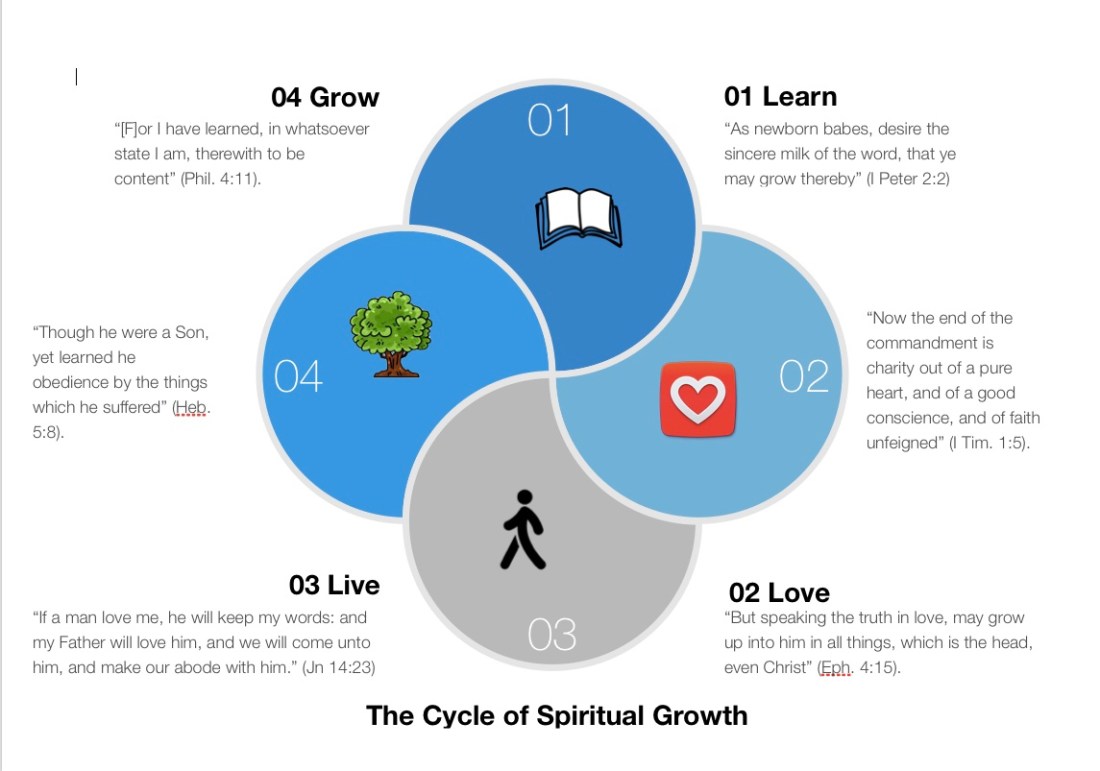
The Cycle of Spiritual Growth

Join us on Sunday mornings during August 2016 for a study of the process of spiritual development. It begins with LEARNING, which, if internalized and applied, will lead to LOVING and LIVING for God. As we live for Him, we GROW and are able to appreciate more of what He reveals to us in His word. And the cycle of spiritual maturity advances.

Here is a quick overview of each stage of growth:Cycle of Growth CHART 2016-08-12 at 9.48.29 PM

Video Bible Class 2016-17

Our monthly Video Bible Class for the 2016-17 school year will be an in-depth study of the Book of Second Thessalonians. Study guides will be available for each class. Classes usually meet for 45 minutes on the second Monday night of the month, beginning at 7:30 p.m.

Overthinking it?

If you’d like to see issues that should be elementary become snarled by overthinking, check out some of the 10 Patents that Make Simple Tasks Crazy Complicated published in 2013 by Popular Mechanics. While items like the Body Squeegee appear to perform as described, these are example of overdrawn solutions to annoyances that could be handled less awkwardly.

Simple matters can become convoluted and puzzling if we are drawn too far away from the real objective. It shouldn’t be a surprise that one of the devil’s strategies is to insert ambiguity into areas where there has been clarity. Paul commented:

“I wish you would bear with me in a little foolishness. Do bear with me! 2 For I feel a divine jealousy for you, since I betrothed you to one husband, to present you as a pure virgin to Christ. 3 But I am afraid that as the serpent deceived Eve by his cunning, your thoughts will be led astray from a sincere and pure devotion to Christ. 4 For if someone comes and proclaims another Jesus than the one we proclaimed, or if you receive a different spirit from the one you received, or if you accept a different gospel from the one you accepted, you put up with it readily enough” (2 Corinthians 11:1-4 ESV).

Thankfully, in our spiritual lives, Christ offers us a straightforward plan for a better life here and now and the best life in the world to come.

VBS 2016

Our one-day Vacation Bible School will be Saturday, June 25, 2016, from 9:30 a.m. to 1 p.m. We will have classes for youngsters and youth through sixth grade. Our subject will be Noah and the Ark.

“By faith Noah, being divinely warned of things not yet seen, moved with godly fear, prepared an ark for the saving of his household, by which he condemned the world and became heir of the righteousness which is according to faith” (Hebrews 11:7 NKJV).

Six Tools for Spiritual Growth

We’ve got a lot of growing up to do… spiritually, that is. Peter urged us to “grow in grace, and in the knowledge of our Lord and Saviour Jesus Christ” (II Peter 3:18). Consider six tools we can use to help us on our path to spiritual maturity:

1. Get into the Word. God’s word has been given to help us on our journey. “All scripture is given by inspiration of God, and is profitable for doctrine, for reproof, for correction, for instruction in righteousness: That the man of God may be perfect, throughly furnished unto all good works” (II Tim. 3:16-17). “Perfect” means spiritually mature.
2. Work out your faith. Do what you know God wants you to do. “But whoso looketh into the perfect law of liberty, and continueth therein, he being not a forgetful hearer, but a doer of the work, this man shall be blessed in his deed” (James 1:25).
3. Send up your prayers. Jesus believed in prayer, too. “And in the morning, rising up a great while before day, he went out, and departed into a solitary place, and there prayed” (Mark 1:35).
4. Upgrade your level of service. If you aim to do your best in every area of life, especially in your religious life, you will improve across the board. “And whosoever shall compel thee to go a mile, go with him twain” (Matt. 5:41). “Just enough” ain’t enough.
5. Share the love. The sign of spiritual maturity is inexhaustible love for all. “And above all these things put on charity [love], which is the bond of perfectness” (Col. 3:14). Desire the best for each person you encounter – beginning with the person right in front of you.
6. Hang in there. A “crown of life” awaits (Rev. 2:10). It will be worth it all.

A God with No Limits

It can be easy to underestimate God. A passage in the Old Testament describes how an enemy of Israel misapprehended the extent of God’s power: “And there came a man of God, and spake unto the king of Israel, and said, Thus saith the Lord, Because the Syrians have said, The Lord is God of the hills, but he is not God of the valleys, therefore will I deliver all this great multitude into thine hand, and ye shall know that I am the Lord” (I Kings 20:28). God’s influence is not limited geographically – or in any other respect.

The Bible describes at least four aspects of God that are incalculable:

1. God’s ways are beyond measure.  His wisdom is infinite.  Zophar misunderstood the nature of Job’s suffering, but he had a fairly good handle on the incomprehensible magnitude of God.  “Canst thou by searching find out God? canst thou find out the Almighty unto perfection? It is as high as heaven; what canst thou do? deeper than hell; what canst thou know? The measure thereof is longer than the earth, and broader than the sea” (Job 3:7-9).  Human wisdom does not compare with God’s. “For as the heavens are higher than the earth, so are my ways higher than your ways, and my thoughts than your thoughts” (Isaiah 55:9).

2. God’s mercy is never-ending. The psalmist wrote, “For as the heaven is high above the earth, so great is his mercy toward them that fear him As far as the east is from the west, so far hath he removed our transgressions from us” (Psalm 103:11-12). God’s supply of forgiveness is inexhaustible.  “If we say that we have no sin, we deceive ourselves, and the truth is not in us. If we confess our sins, he is faithful and just to forgive us our sins, and to cleanse us from all unrighteousness” (I John 1:8-9).

When we consider the extent of His generosity toward us, it should prompt us to be more grateful to Him: “Enter into his gates with thanksgiving, and into his courts with praise: be thankful unto him, and bless his name. For the Lord is good; his mercy is everlasting; and his truth endureth to all generations” (Psalm 100:4-5).

3. God’s love is infinite. Paul desired that we “may be able to comprehend with all saints what is the breadth, and length, and depth, and height; And to know the love of Christ, which passeth knowledge, that ye might be filled with all the fulness of God”  (Eph. 3:18-19).  But we will never fully grasp His love for us.

Jesus demonstrated His love on the cross of Calvary.  “Greater love hath no man than this, that a man lay down his life for his friends” (John 15:13).  His sacrifice for our sins ought to move us to trust and obey Him as His servants (John 12:32).

4. God’s presence is endless.  You and I have a birthday, and later, one day our lives on this earth will come to an end.  “[I]t is appointed unto men once to die, but after this the judgment” (Heb. 9:27). But God has no beginning or end.  God told Moses he could refer to Him as “I AM THAT I AM: and he said, Thus shalt thou say unto the children of Israel, I AM hath sent me unto you” (Exodus 3:14).  God is eternal.  Moses later wrote, “Before the mountains were brought forth, or ever thou hadst formed the earth and the world, even from everlasting to everlasting, thou art God.” (Psalm 90:2).

God is not limited by anything.  And He can provide us with immeasurable blessings.  He “is able to do exceeding abundantly above all that we ask or think” (Eph. 3:20).